
PIt may come as a surprise, but going green isn’t always popular. If you want to live and travel sustainably, you’re on trend – but statistically speaking, you’re still in the minority. That’s because it’s not always compatible with accepted behavior at your destination. This article will show you how to combine both travel etiquette and eco-etiquette.
Table of Contents: Travel Etiquette vs. Eco Etiquette
“No, thank you” – how to say no or decline politely
Our tip 1: Express your zero-waste beliefs as personal requests
Tip 2: Avoid buffets, eat mindfully and order smaller portions
Different portion sizes would mean less food in the trash
Digression: What does politeness and travel etiquette have to do with sustainability?
Sustainability and courtesy at the spa
The rules of courtesy – wellness etiquette
Bathrobes and towels create mountains of laundry
Mountains of waste from disposable slippers
Dealing with waste and disposable products
Can I take skin care products from the hotel home with me?
Waste separation in the accommodation
Travel etiquette: How much is a polite tip?
Free download: Your travel etiquette printable for sustainable and courteous travel behavior

“No, thank you” – how to say no or decline politely
For us and many other sustainable travelers, part of the politeness is learning how to greet, say goodbye, and thank people in the local language (with the appropriate gestures, of course).
We add “No, thank you” as part of the eco-etiquette. Learn how to politely (!) refuse something. In the Zero Waste movement, “refuse” is the first rule of waste reduction. Zero Waste icon Bea Johnson, for example, refuses all packaged food and all plastic-wrapped swag and hotel goodies.
Our tip 1: Express your zero-waste beliefs as personal requests
- “Can you please put my coffee in this cup?”
- “Could you put my groceries in this bag, please?”
- “Would you mind if I fill my own water bottle?”
In general, most people in the tourism industry are happy to accommodate special personal requests (in fact, they should be trained to do so).
The courtesy is to simply say what you want, without lecturing your counterpart that it is environmentally irresponsible to set up a water dispenser with disposable cups.
Even when visiting a local market or supermarket, being friendly and asking a polite question (preferably in the local language) will often get you by without extra plastic bags or disposable cups. And if it happens? Take it easy! Reuse plastic bags and dispose of the cups properly.
Some Green PearlsⓇ partners, such as the Hotel Luise in Erlangen, Germany, or the Hotel Weihrerhof in Oberbozen, Italy, are members of Refill. This means that even non-hotel guests can fill their own water bottles with tap water. Refill stations can be found through the Refill app.
Tip 2: Avoid buffets, eat mindfully and order smaller portions
Buffets tend to waste more food than à la carte orders. This is mainly because anything that has already reached the guest is not allowed to go back to the kitchen. So when hotels offer buffets for all meals as an all-inclusive service, it is not a sign of sustainability.
However, a breakfast buffet is still common, mainly because it is convenient. Hybrid offerings are also on the rise: Breakfast classics can be picked up at the buffet, while hot dishes such as eggs, pancakes and the like are available freshly prepared to order.
The official rules of buffet etiquette have already been adapted to sustainability. For example, they state that “wasting food is out”. A full plate does not make a good impression, but queuing several times at the buffet is perfectly appropriate. Of course, you should not be rushing, and you should take the food out in such a way that it still looks appetizing to the next person.
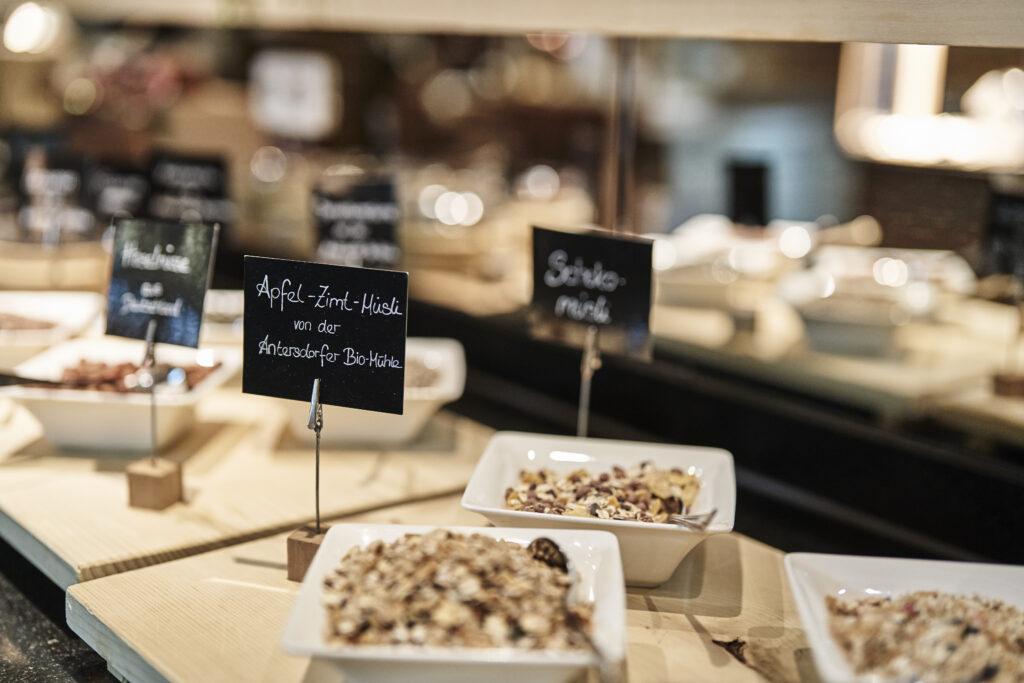
Different portion sizes would mean less food in the trash
In February 2023, consumer watchdogs conducted a market check (german) in restaurants across Germany to see if there were different portion sizes to choose from. This is one of the many points of the National Strategy to Reduce Food Waste. The survey found that only one in five restaurants offered multiple portion sizes.
At the CERVO Mountain Resort in Zermatt, Switzerland, staff have long been trained to tell diners on the à la carte menu that they can choose a smaller portion. So if you are the kind of person who always leaves half, you can take advantage of such an offer. Again, it pays to learn the phrase in the local language.
The rule of eco-etiquette is: Just because something is “free” or you have “paid” for it does not mean you have to take advantage of it.
Digression: What does politeness and travel etiquette have to do with sustainability?
Before we move on to travel etiquette, let’s take a brief look at why politeness is part of sustainability in the first place. If you look at the “three-pillar model of sustainability,” sustainable development must consider three areas: Environmental, Economic and Social. This means that in addition to environmental and economic goals, there is also a social goal of fairness. In recent years, this issue has been raised particularly in business, where it is treated as part of “corporate governance”. The essence is, that fair and respectful treatment of people – across all ethnic and social components – is part of sustainability.
Sustainability and Courtesy at the spa
People go to the spa for three main reasons: Rest, relaxation and health. It is a place of peace and hygiene.

The Rules of Courtesy – Wellness Etiquette
By the way, wearing your own slippers is also part of the official wellness etiquette! But for a different reason. Because, according to behavioral consultants, hotel slippers are simply not made of the right material for a wet area, and for this reason, your own slippers are better.
- Arrive on time for spa treatments
- 10% tip and a “thank you” after a spa treatment
- Refrain from cell phones and other distracting noises
- Find out about the dress code beforehand – for example, is there a restaurant where you can wear a bathrobe (and the aforementioned slippers)?
The vegan/vegetarian Dolomite hotel Paradiso Pure.Living on the Alpe di Siusi in South Tyrol, Italy, realized that the free slippers they provided “resulted in a mountain of slipper waste every season”. Since then, the hotel has asked guests to bring their own slippers when they make their reservations and only provides eco-fabric slippers on request. The family-friendly Hotel Weihrerhof on the Ritten in South Tyrol and the organic hotel Bella Vista Zermatt next to the Swiss Matterhorn are doing the same.
Bathrobes and towels create mountains of laundry
In addition to your own slippers, you can also bring your bathrobe to the hotel. According to the online portal Hotelier.de, a medium-sized hotel with 60 beds has to wash an average of 9,000 kg of laundry (bed linen and towels) per year. This consumes electricity and water and (with conventional alkaline detergents) stresses the water treatment of the public utility. At the same time, changing towels every day is really unnecessary, as you know from your own home.
The general rule is:
- Towels on hooks = do not wash
- Towels on the floor = change them

Usually, there is also a notice in your room stating how your hotel usually does things. Unfortunately, it can always happen that the cleaning staff is not really trained or just forgets. My personal tip is to hang the towels back on the hook as neatly folded as you found them – then there is a better chance they will not be taken away.
You can read more about eco-friendly hotel linen in this blog post. The SCHWARZWALD PANORAMA Hotel in the spa town of Bad Herrenalb, Germany, is a good example. Here, the laundry is washed in an environmentally conscious (external) laundry with eco-detergent. Guests also receive a lavender sachet with the inscription “No room service today! The environment thanks you!” to hang on the door.
Mountains of waste from disposable slippers
Providing guests with slippers is still part of the service in so-called “better” hotels. In response to a question from Focus magazine about whether you can take them home, the Best Western hotel group replied that the slippers are “100 percent disposable products”. Or in other words, you’re allowed to take them home, but their ultimate destination – after a single use – is the trash can! This is no small matter. The Accor hotel group, for example, orders about 100,000 disposable slippers each year!
If you don’t want to add to this mountain of waste, bring your own slippers.
Dealing with waste and disposable products
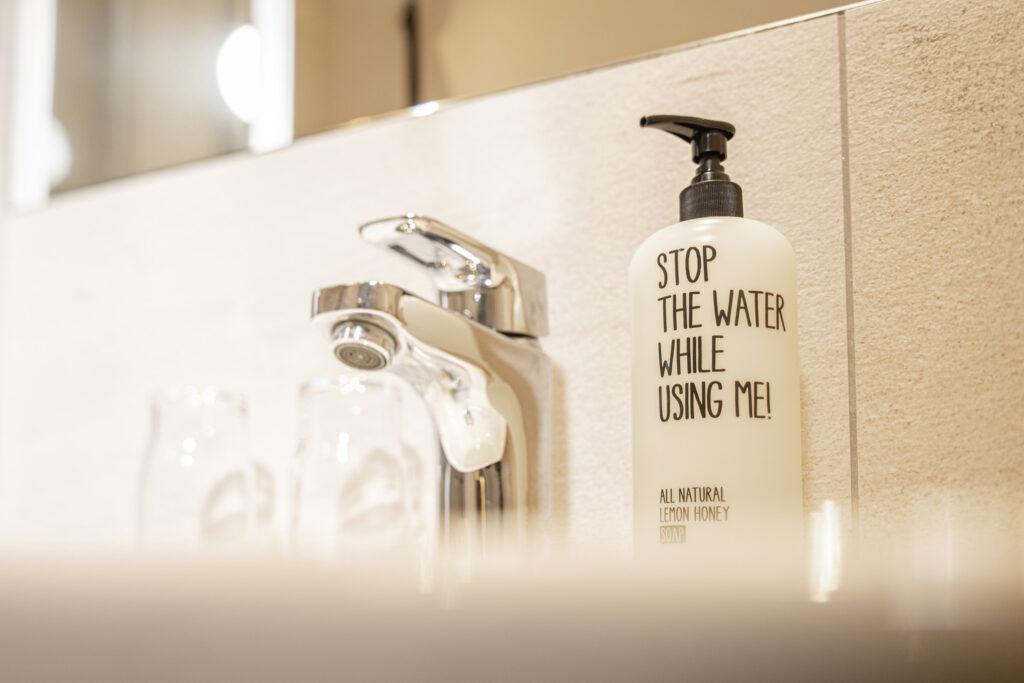
Disposable Toiletries
In the bathrooms of many hotels and holiday homes, you’ll find a range of cosmetic products in addition to hairdryers and towels: Soap, shampoo, shower gel and body lotion – they are all there to make you feel good. Unfortunately, the small, disposable packaging that is often used creates a huge amount of plastic waste! Products that are opened and not used become trash. Conventional cosmetic products also often contain environmentally harmful substances such as microplastics, which end up in wastewater during use.
What can you do? Join the zero waste movement and simply refuse and avoid single-use packaging. (You’ll have to carry your own shampoo bar in a metal can, of course). When you break the small packaging, take the rest home and use it there. You can reuse the small plastic bottle on your next trip.
The HUBERTUS Mountain Refugio Allgäu uses sustainable natural cosmetics and has installed dispensers in all bathrooms that are filled with refills. The lifestyle hotel SAND at the Baltic Sea does the same.
Can I take skin care products from the hotel home with me?
By law, you are NOT allowed to take small (unused) toiletries and other amenities from a hotel. The only exceptions are opened disposable products such as toiletries, shower caps and slippers. The German Hotel and Restaurant Association (DEHOGA) reports that some guests unscrew the aerator from the faucet and steal the batteries from the remote control. As the guests rightly assume, it is “not worth the effort” for the accommodation to send a bill for this afterward. However, this does not change the fact that such behavior is guaranteed not to be polite, but simply impertinent.
Waste Separation in the Accommodation
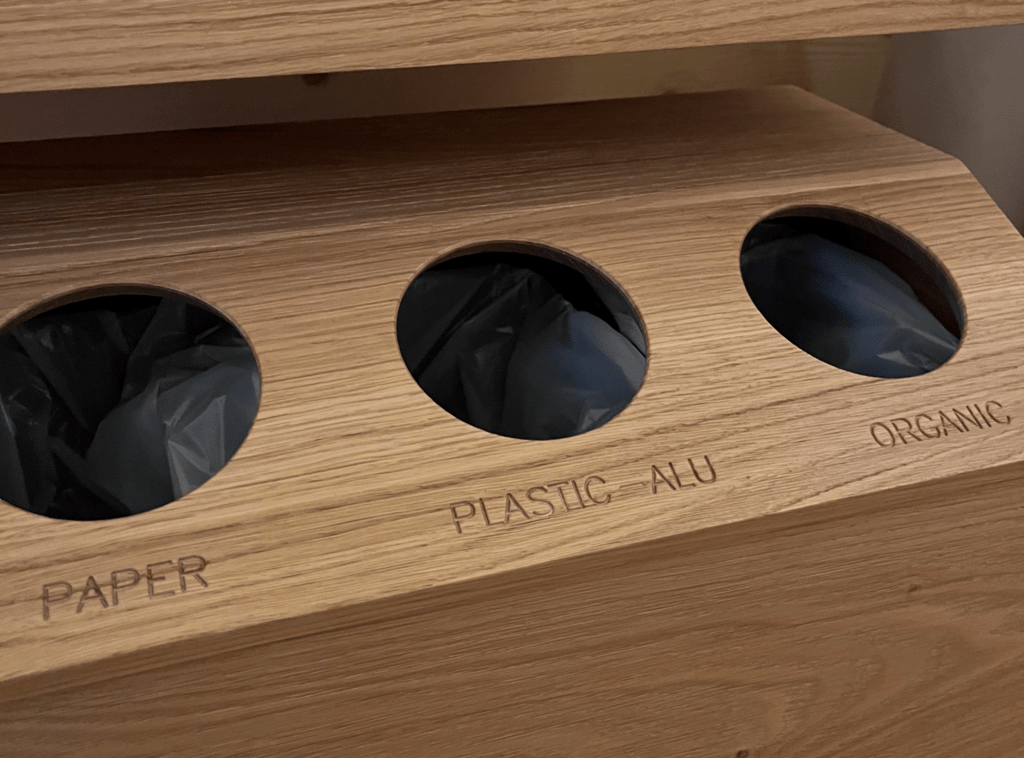
Often there is only one wastebasket in the apartment or in the hotel room, where all the garbage ends up. This is where the environmentally conscious need to take the initiative: Ask at the reception if there is a possibility to separate waste. For example, if there is a paper bin behind the building, you can dispose of your paper waste there before the recyclable wood fibers end up in the incinerator.
Of course, it would be more convenient if the accommodation had a waste separation system in the rooms. In the apartments of A’ Cràpa Mangia, on the Mediterranean coast of southern Italy, there are four different bins in each apartment: paper, plastic, organic waste, and residual waste. There is also a glass container in the parking lot. Also, in the luxurious ADLER Lodge RITTEN, there are several bins available for the guests to separate their waste.
Travel etiquette: How much is a polite tip?
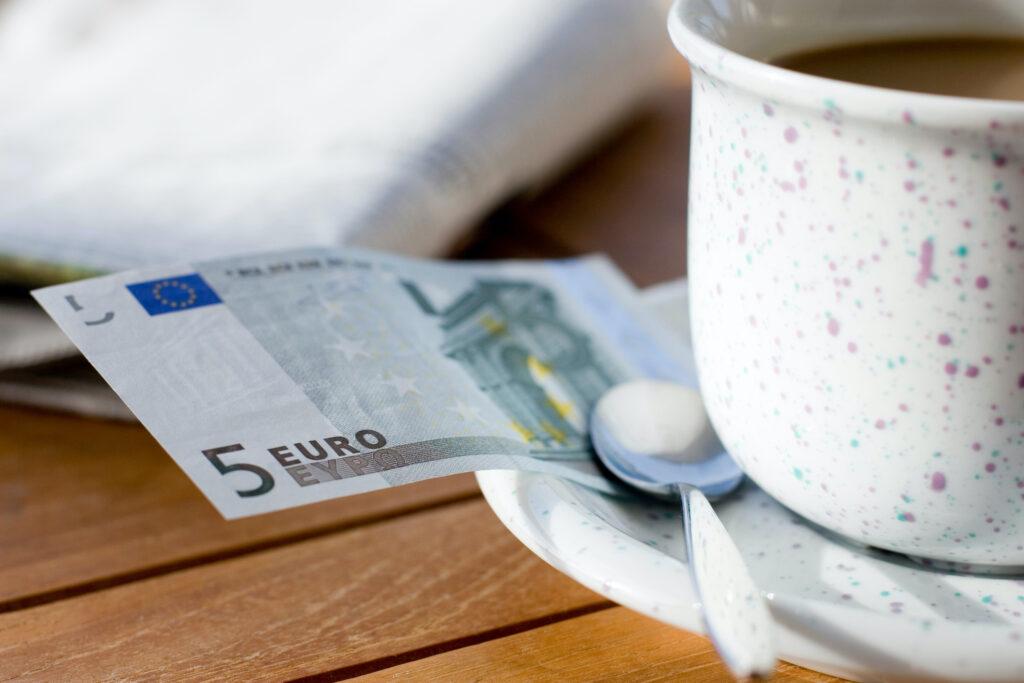
In general, staff in hotels and vacation homes are always happy to receive a tip. Exceptions are Japan and China, where tipping is not part of the culture. (I have heard, however, that this has changed in international hotels and resorts. When in doubt, ask the front desk how to show your appreciation). In most countries of the world, however, tipping is a way of showing appreciation and thanks.
The best thing to do is to find out before you travel what the customary tip is in the country you are visiting. A general rule of thumb is as follows:
- The housekeeping staff receives about one euro per night – it’s best to leave this on your pillow or on the bathroom shelf with a “Thank You” post-it note to make it clear that this is a tip.
- In a restaurant, about 10 percent of the bill is considered fair.
- In a taxi, round up the fare.
- According to etiquette experts, a tour guide receives about 10 to 20 percent of the cost of the tour. For a half or full-day tour, 20 euros is reasonable (this is for the group, not for each person).
In terms of sustainability, you should try to support the local population during your vacation, for example by eating in local (preferably organic) restaurants instead of international chains.
In general, it doesn’t always have to be money. If you simply thank the receptionist when you leave your holiday accommodation, you will certainly leave a good impression and be remembered as a “welcome guest”. Even if you had “funny” views, your extra requests were “strange” and you refused plastic cups, slippers and daily cleaning 😉
Free download: Your travel etiquette printable for sustainable and courteous travel behavior
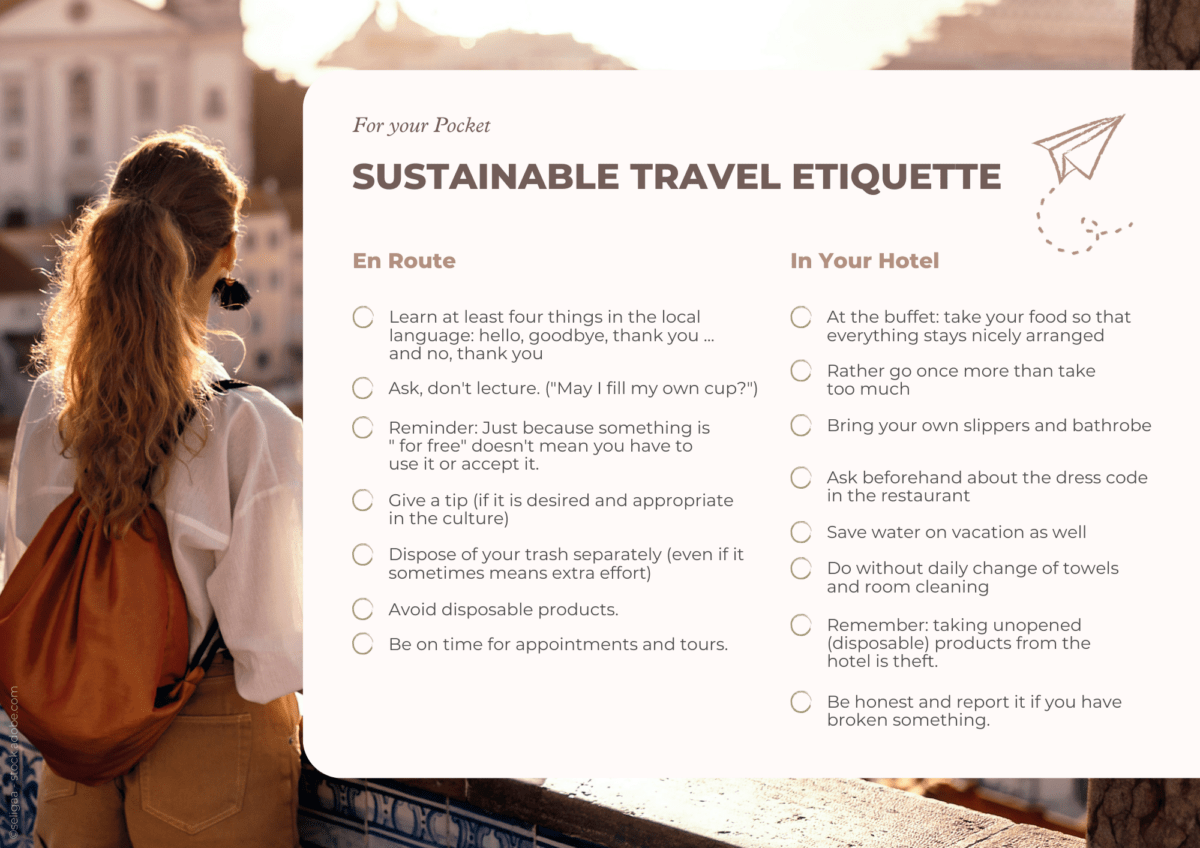
Save the post so you have it ready before your next trip.