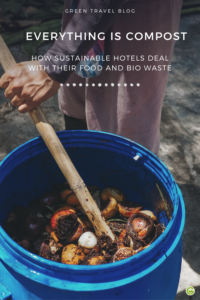
Everyone knows it: we chop fruit and vegetables; we have scooped too much onto our plates or something spoils in the kitchen despite all precautions. Without thinking about it, the waste goes into the organic waste garbage can, on the compost, or if there is no other way, into the residual waste. But have you ever wondered what it’s like in a hotel? How do sustainable hotels use natural recycling, for example? Or how does compost and leftover recycling work in the turbulent everyday kitchen life of a restaurant? Let yourself be inspired by these great examples that we have discovered among our green pearls.
The classic: compost
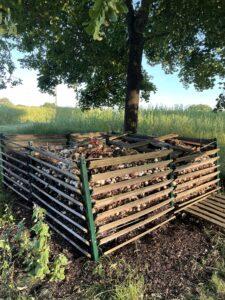
Of course, it’s nice when leftovers can be reused for consumption, but unfortunately, sometimes the only option is the trash can. In that case, it is important to separate the leftovers appropriately. For organic waste (vegetable, raw) the good old compost is a classic. The Biohotel Sturm makes good experiences with exactly this. Sufficient aeration and contact with the soil are important so that the food leftovers can quickly combine with the necessary microorganisms in already existing soil. With the quantities that accumulate even in a sustainable hotel, the compost must, of course, be big enough. To ensure the transformation of the leftovers into humus gets off to an optimal start, the Biohotel Sturm weighs it down with pallets. After just six months, the gardeners can use the topsoil as fertilizer in the hotel’s own herb and vegetable garden. Other kitchen waste is disposed of in a nature-friendly way via Refood , where it is converted into environmentally friendly energy. The company guarantees “transparent traceability of all residual materials
Avoiding animal waste
What is actually allowed to end up on the compost, you ask? Organic waste, which is decomposed into compost (humus), includes only organic and uncooked waste. Animal waste, such as meat and bones, decomposes very slowly and attracts uninvited guests, such as rats. The Eco Aparthotel The Dreamers Club also uses the classic compost behind the house. Since this green pearl offers you 90% vegetarian and vegan breakfast, there is consequently little animal waste. Our environment says thank you.
Rocket Composter as an on-site solution
Another option for a sustainable hotel to dispose or compost plant-based waste on a larger scale is the Rocket Composter, which we discovered at the sustainable 5* hotel Gili Lankanfushi. As a hotel in the Maldives, Gili Lankanfushi is facing special challenges, as any waste either remains on the island and littering it, or has to be transported to the mainland. So, an on-site solution was needed. The Rocket Composter offers a simple, clean and relatively space-saving way to not only dispose of organic food scraps, but to turn them into nutrient-rich compost. The sustainable hotel uses only specially produced compost from the Rocket Composter in its home herb and vegetable garden. A great example of circular economy, don’t you think?

Organic fertilizers in the vegetable garden
At Keemala in Thailand, the emphasis lies on respect for the natural environment and therefore also on the sustainable handling of all waste. Water comes in glass bottles, cosmetics are wrapped in recycled paper or fabric, and there are various bins for waste separation in the guest rooms. This green gem gets more than half of its daily supply of fresh, nutrient-rich ingredients from its on-site vegetable garden. In the garden, Keemala staff use only bio-organic fertilizer made from organic waste. Not only does this reduce emissions for transportation of produce, but products are guaranteed fresh! Over-produced food is redirected by the resort to disadvantaged communities and orphanages on Phuket through its partnership with the Scholarship of Sustenence
Chemical-free cleaning products made from waste
Who knew you could clean with trash? The Tongsai Bay on Koh Samui extracts a solution from the peel of fruit to do just that. So-called EMs (Effective Microorganisms) are included in cleaning products for the bathroom, enabling chemical-free and environmentally friendly cleaning. A circular economy that is something to be proud of, we think.

Waste recycling by goats and donkeys
At A’Cràpa Mangia, animal helpers work together to ensure that nothing is thrown away. For you as guests, the topic becomes directly tangible because you can feed your salad scraps to the goats and donkeys yourself. The team of the sustainable vacation resort always keeps an eye on the amount of waste and reduces it whenever and wherever possible. Since the offer of the estate with its vacation apartments is aimed at self-catering, there are no cosmetic items available. The use of a deposit bottle system also greatly reduces plastic consumption at A’Cràpa.
Creative use of leftovers
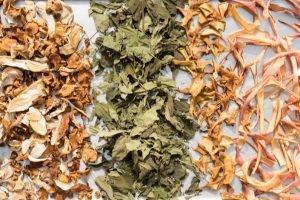
As another excellent example of the fact that creativity has no limits, the restaurant of the Genießerhotel Die Forelle should not be missed at this point. Fruit and vegetable peelings no longer end up on the compost heap. Dried and pulverized, the leftover cuttings are turned into an exceptional ingredient that the kitchen team of the sustainable hotel uses to refine dishes for you. You will be thrilled!
Adapted portions with room for improvement
For some of our green pearls, the topic of compost and the use of leftovers begins quite naturally with the menu planning. The HUBERTUS Mountain Refugio attaches great importance to this aspect and has adjusted the portion sizes. Didn’t get your fill after all? Then feel free to ask for another side dish. The HUBERTUS team prefers this to having something left over. Communication during the catering certainly plays an important role here!

Want to help? Of course!
As you can see, our green pearls live the topic of sustainability as well when it comes to compost and recycling of leftovers. In most cases, these are just a few steps that take barely any extra time to make a huge difference in the area. Moreover, with the extraction of compost, a wonderful cycle of valuable added value is created.
And yet, restaurants and hotels can’t avoid waste altogether, and that’s where you come in. Your involvement is vital when staying at a hotel, so being environmentally friendly is becoming more and more natural: Many hotels have bins and the relevant information on how to separate waste correctly on site. By using these, you are helping to ensure that the staff can clean effectively. (If you’re interested in what happens behind the scenes after you leave, you can read about it here.
The use of our green pearls, from classic to innovative in terms of compost and leftover recycling inspires us. Do you know of other ways to address these issues that don’t show up here but are proving effective in your own household, for example? Do you have experience with compost and the like? Please let us know.
You want to get more inspirations on the topic? Pin it by saving the image or clicking on the Pinterest button below!