
When thinking of Switzerland, the first thing that probably comes to mind are the mountains. No wonder, since about 70 percent of the country is mountainous. Here you can still enjoy unspoiled nature. But the Swiss Alps have two enemies: climate change and mass tourism. The only solution (not only from our point of view): sustainable tourism. In this article, we’ll give you some tips on how to have a sustainable vacation in beautiful Switzerland.
A green destination in the heart of Europe: Switzerland
Situated between Germany, Austria, Italy and France, Switzerland’s central location makes it easy to reach from any part of Europe. The beautiful alpine landscape, with its year-round snow-capped mountains, glaciers, lakes, waterfalls, forests and meadows, makes it an especially attractive travel destination. No less than 48 Swiss mountains are over 4000 meters high.
There are two main tourist seasons in Switzerland:
- the cold season for winter sports and
- summer for hiking and mountain biking
And it is precisely in these seasons that Switzerland is facing more and more problems.
Challenges in the alpine paradise

Problem #1: Climate change endangering alpine glaciers
In 2023, a study involving the University of Zurich examined the effects of climate change on glaciers. The study, published in the journal Science, analyzed changes in glaciers throughout the 21st century. It concluded that even if the climate goals of the Paris Agreement are met and global warming is slowed to +1.5°C, almost all glaciers will soon disappear.
“Even in the best-case scenario, 1100 to 1200 of Switzerland’s 1400 glaciers will disappear by 2100.” – Matthias Huss, Head of the Swiss Glacier Research Institute, ETH Zurich, interviewed by SRF
A little digression on glaciers
Glaciers are ice fields formed by layers of melted snow. Alpine glaciers were formed during the last Ice Age, a period that lasted about 100,000 years and ended about 10,000 years ago. For a glacier to remain intact, there must be more snowfall than melting each year.
In addition to feeding rivers and lakes, glaciers contain 70 percent of the world’s freshwater, making them our largest freshwater reservoirs. If they disappear, the consequences for the global climate will be severe. (Keywords: sea level rise and freshwater scarcity)
Problem #2: Mass tourism in the Alps

In 1992, a group of researchers crossed the Alps and repeated the same journey 25 years later (2017). They found “enormous changes” in this short period of time. Among them, the aforementioned melting of the glaciers, but also tourism. While in the 1990s there were only a few tourists from oversea-destinations like China, today there are many more, and in some places there is even a tendency towards mass tourism.
But what exactly is the problem? Tourism means new hotel complexes, highways and parking lots. According to the scientists, this will not immediately destroy the Alps, but it must be ensured that the development is based on a sustainable concept.
Is an increase in tourism a good or a bad thing for Switzerland?
Tourism has its drawbacks, of course, but so far the benefits have outweighed them. Including:
- Intercultural interaction (promoting exchange and tolerance)
- Landscaping (nature is preserved to remain attractive to tourists)
- Protecting culture and customs
- Providing additional income for many farmers
- Providing a boost to the local economy
- Creating value
What is sustainable tourism?
Most of the emissions generated by a holiday occur during travel. But there are a lot of other aspects that contribute to sustainable tourism. To learn more about what makes travel and tourism sustainable, check out our sustainable travel briefing or our expert tips.
Tip: Take advantage of the off-season
Switzerland is charming in all four seasons and is also a wonderful destination to visit in spring and fall.
In spring, enjoy Switzerland’s cherry and apple blossoms, marvel at the waterfalls that emerge from the melting snow, or visit baby animals in one of the many wildlife parks.
In fall, forests are vibrant with color, making this a popular time for scenic hikes and train rides.
An advantage of the low season is that accommodations and activities are usually less expensive. In addition, there are fewer tourists crowding the valleys, cable cars, and attractions. And in terms of sustainability, low season has the advantage of reducing environmental impact by spreading the flow of visitors throughout the year.
A sustainable vacation in Switzerland – Here’s how to do it right!

Travel tips
Switzerland is ideal for traveling by train. Use either the national SBB or other European railways such as TGV Lyria, ÖBB, Trenitalia or Deutsche Bahn. And since Switzerland is a small country, distances are never too far.
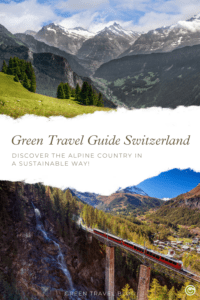
But that’s not all – there are first-class panoramic routes as well. The most beautiful routes are offered by the:
- Glacier Express
- Bernina Express
- Gotthard Panorama Express (from April 20. 2024)
Another environmentally friendly way to travel is by coach, such as FlixBus. Studies have shown that long-distance coaches have an even smaller carbon footprint than trains. It is also the cheapest way to travel.
On-site mobility

Switzerland has many car-free resorts. Including beautiful Zermatt at the Matterhorn and Saas Fee. You can reach Zermatt by train, and once there, explore by electric taxi, cable car, and on foot. E-bikes are another great option. They can be rented locally, and many sustainable accommodations have bike rooms with charging stations, cleaning and repair services.
At the Waldhotel Fletschhorn in Saas Fee, you will receive the Saastalcard, a guest card that allows you to use public transportation free of charge. In summer, the card even includes the use of the mountain railways.
Excursus: Are cableways environmentally sound?
To build a cable car, forest is cleared for the track, there are cable car stations, and the cable car itself consumes materials and resources. The cable car then needs to be powered. Once the mountain tops are continuously accessible, more people come and leave more tracks.
So, if the question is, if it is more sustainable to climb the mountain on foot or to build a cable car, the answer is: If nothing is built at all, fewer people (both tourists and locals) will come to the mountains and nature will remain undisturbed.
(Funny story: about 40 years ago, the then popular ARD TV prank-show “Verstehen Sie Spass” showed extreme mountaineer Reinhold Messer with a kiosk just below the summit of the Matterhorn. You can imagine his reaction 🙂 )
Advantages of the cable car
However, if the political decision has been made to connect two points (e.g. village 1 and village 2 or valley and mountain) and there is only a choice between different means of transportation, the cable car is often the most environmentally friendly choice. The reasons are as follows:
- Today, almost all cable cars run on electricity (e-mobility).
- CO2 consumption is lower (according to the online magazine Schneehöhen, a trip in a cable car produces 27 g of CO2, in a train with an electric locomotive 30 g, in a diesel bus 38.5 g and in gasoline-powered car 248 g – in each case at 50% capacity).
- Less land is cleared for a cable car route than for roads – especially for the serpentine needed on mountains.
- Cable cars are quieter than other means of transportation and therefore produce less noise emissions.
We must also consider the social aspect. Thanks to cable cars, the special nature of the mountains is also accessible to people who would not be able to reach the summit or a higher location on foot. This includes the elderly, the sick and the disabled, as well as young parents with strollers.
Sustainable Swiss hotels
After arrival, eco-friendly accommodation is the next big component of a sustainable vacation in Switzerland. This small country offers a wide range of accommodations, from vacation apartments and mountain chalets to luxury hotels. Here are three of them:
Biohotel Bella Vista Zermatt – The cozy family hotel

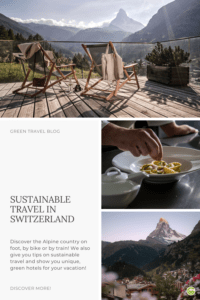
Located in the heart of the Swiss Alps, the Biohotel Bella Vista Zermatt is a wonderful place to relax. There’s a wellness area with a Swiss stone pine room complete with waterbeds. Only 21 rooms and a large terrace with a direct view of the Matterhorn. A cozy fireplace crackles in the lobby, and the host family will treat you to an organic breakfast and afternoon cake.
CERVO Mountain Resort Zermatt – Exceptional design resort


The CERVO Mountain Resort, also in Zermatt, consists of several buildings. There are three restaurants (one of which is completely vegetarian/vegan) and a special interior style based on the nomadic lifestyle, for which the stunning hotel has won several design awards. The atmosphere is luxurious, yet very casual. A truly memorable experience!
Waldhotel Fletschhorn – The hotel for connoisseurs
Don’t you think food just tastes better on vacation? Sitting down to a beautifully laid table after an eventful day in the fresh mountain air, with plenty of time to really enjoy it – there’s nothing like it! If you are looking for culinary excellence, we recommend the Waldhotel Fletschhorn.
Here you will find a concept restaurant known far beyond the borders of Saas Fee, which will spoil you from morning to night, from à la carte breakfast to a huge selection of wines. Almost all the ingredients are regional (organic) and from selected producers. For dinner, enjoy authentic Swiss raclettes, fondues or a personal BBQ. The latter will be prepared directly at your table (on the terrace in summer) with a view of the mountains.

Favoring local food on vacation
In a sustainable hotel, your food is made from local (organic) ingredients. However, you should also consider choosing local ingredients when shopping, cooking or eating out.
The regio.garantie label, the Aus der Region label from Migros and Bio Suisse are points of reference for your shopping. The Bio Suisse label certifies food that not only comes from Switzerland (at least 90%), but also meets the criteria for organic farming / animal husbandry.
Sustainable activities in Switzerland

The best way to explore Switzerland is in the fresh mountain air – on foot or by e-bike. In this blog article, you can already find some hiking trails that are easily accessible from the Green Pearls® hotels.
It is also interesting to take a tour with a mountain guide, who will not only show you the area, but also tell you a lot about the flora and fauna.
In addition to hiking (in winter with snowshoes or touring skis) and mountain biking, there are other environmentally friendly ways to get active. For example, horseback riding or canoeing on Swiss waters.
The topic of winter sports would go beyond the scope of this article 😀 Therefore, you’ll find a lot of knowledge and tips in this blog article. Additionally, you can find out if skiing and winter sports can be sustainable and what that looks like.
You can also take a sustainable city trip by train. In Bern, Basel, Lucerne and Zurich, for example, there are many beautiful vintage and second-hand shops where you can do some eco-friendly shopping. And of course there is art, culture and churches to visit, as well.
In case you happen to be in Switzerland in September, you can also participate in the “Clean-Up Day” that takes place every year in that month (this year’s date is Saturday, 09/14/2024)
To relax after all the activities, the wellness facilities of our featured hotels are, of course, the ideal place to go.
Sustainable activities in Switzerland at a glance
- Hiking
- Cycling
- Snowshoeing and sustainable winter sports
- Horseback riding
- Stargazing (light pollution is very low in the mountains)
- Forest bathing
- Canoeing
- Wildlife watching (birding, Big 5 of the Alps)
- Vintage-Shopping
- Cabaret and culture
- Panoramic train rides
- Clean-Up-Project
We hope we have given you a comprehensive insight into sustainable travel in Switzerland. Have you ever been there? How did you like it?
Save this Guide for your next vacation in Switzerland!


Gratulation, one of the best blogs of Swiss landscape. It would be lovely to read something about the region of the Bernese highlands, or Berner Oberland as they call it.