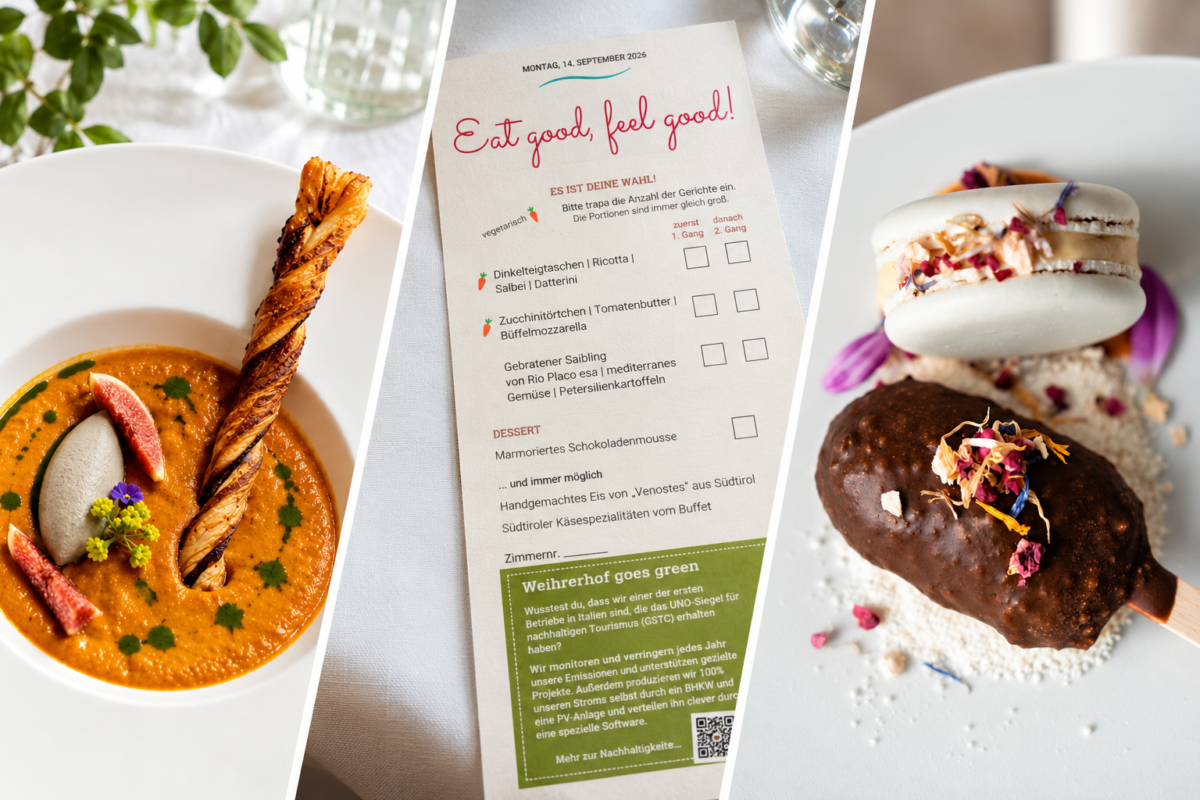
Twelve starters, eighteen main courses and a whole separate page for the children’s menu? What used to seem like a generous selection now feels outdated. Read on to find out why menus are getting smaller. PHOTO: Left and right: dishes from the five-course menu at LA VIMEA. Centre: the small menu from the Hotel Weihrerhof.
Why fewer dishes can make sense
A large menu requires the purchase, storage, and preparation of a variety of ingredients, without knowing what guests will order. A more compact menu makes it easier to plan quantities, streamline kitchen operations, and reduce food waste. These are compelling arguments, especially with rising food costs and a shortage of kitchen staff (even outside of restaurants explicitly focused on sustainability).
Studies show: The brain becomes “decision-fatigued” when there are more than 10 main courses to choose from
Even guests don’t necessarily view more choices as better. The “Paradox of Choice” describes how too many options can make decision-making more difficult. One study on menu selection in restaurants concluded that six options per category are sufficient for guests in the fast-food sector, while a maximum of ten main courses and seven to eight options for appetizers and desserts are sufficient in the fine-dining sector.
Small menus for greater sustainability
We asked hotels in the Green PearlsⓇ network if they had scaled back their menus, and several restaurateurs confirmed this:
Hotel Weihrerhof, South Tyrol, Italy
Klaus Pichler, the host of the Hotel Weihrerhof, sees a smaller menu primarily as an opportunity to more effectively plan purchases and kitchen operations:
“Yes, our menu has gotten smaller—and that was a deliberate choice. For us, fewer choices don’t mean lower quality—quite the opposite. A smaller menu helps us cook with fresher ingredients, source more locally, plan quantities better, and reduce food waste.”
Lerchenhof Castle, Carinthia, Austria
Johann Steinwender, the host and chef at Schloss Lerchenhof, views small menus as a means of embodying the Slow Food concept:
“Our menu has intentionally become smaller, especially since the establishment of the world’s first Slow Food Travel Region. Now, our selection is even more closely guided by what nature, the season, our own farm, and our regional producers actually have to offer.”
LA VIMEA & Paradiso Pure.Living Vegan Hotel, South Tyrol, Italy
At LA VIMEA and the Paradiso Pure.Living Vegan Hotel, the commitment to simplicity extends even further. Instead of an extensive traditional dinner menu, there is a five-course menu that changes daily. Executive Chef Aggeliki Charami developed the culinary concepts for both hotels. The hotels explain their decision as follows:
“Typically, four- and five-star hotels offer their guests a wide variety of food, resulting in a lot of food waste. Our kitchens prepare a fixed 5-course gourmet menu every evening that changes daily. This allows us to make precise calculations and avoid wasting very high-quality organic products, while also encouraging guests to trust the kitchen and its high quality.”
Hotel Bella Vista, Zermatt
The small menu at the Hotel Bella Vista Zermatt is based on a completely different approach. The Anthamatten family runs the hotel and cooks for their guests themselves—including family recipes:
“Since we don’t have a kitchen staff and prepare everything ourselves, our menu is small but exquisite. We’ve already added one dish for the summer season and plan to offer an additional option in the winter. Demand for dinner at our hotel is growing, particularly among weekday guests who appreciate having the option to not always eat out. However, our philosophy remains the same: regional, seasonal cuisine.”
Are small menus a sign of quality?
Let’s put it this way: They have the potential to do so 🙂