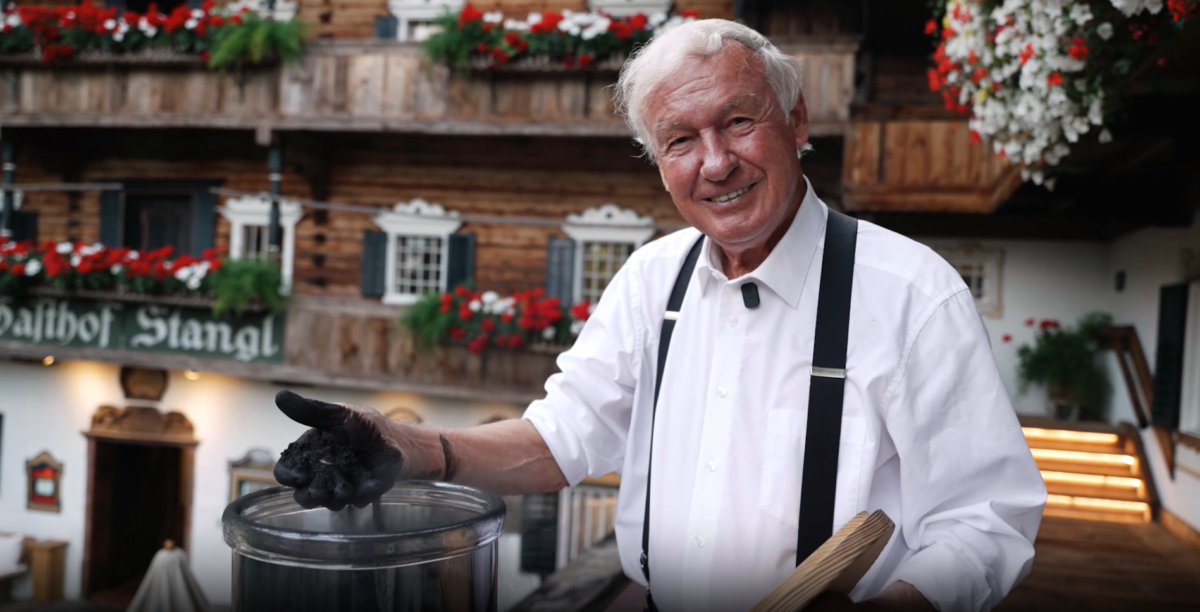
The release of CO₂ during the burning of wood chips or wood pellets is equivalent to the amount of CO₂ absorbed by the tree prior to its transformation into fuel. But what if some of that carbon never made its way back into the atmosphere? This is exactly where biochar comes into play. (Image: Balthasar Hauser with biochar he produced himself. Screenshot from the Stanglwirt promotional video about the bioenergy power plant.)
What is biochar?
Biochar is produced by heating plant material, such as wood, in the absence of oxygen. That process is called pyrolysis. Some of the carbon remains bound in the biochar during this process and can be stored for centuries.
Wood pellets and wood chips are fuels, while biochar is a byproduct of energy production.
Due to its porous structure, it can absorb water and nutrients. As a soil amendment, it can improve soil quality. However, it contains few readily available nutrients for plants, so it is typically mixed with compost or manure.
Is biochar truly beneficial for the climate?
The German Federal Environment Agency (UBA) views it as an opportunity for long-term CO₂ storage but also acknowledges the risks associated with its production. If produced improperly, it can generate fine particulate matter, methane, and other pollutants.
If you want to buy some for your soil, the UBA recommends looking for the European Biochar Certificate (EBC).
Professional systems can control the manufacturing process and recover energy from generated gases and waste heat.
A hotel as an energy pioneer
That’s exactly what the Organic Green Spa Resort Stanglwirt in Tyrol does. Since 2024, this Green Pearls® partner hotel has operated a SynCraft wood gasification system, generating electricity, heat, and biochar from locally sourced wood chips.
According to Stanglwirt, approximately 20 percent of the carbon originally contained in the wood remains bound in the char. It is then sold for agricultural use, among other things.
“That’s how we turn coal into coal,” explains junior boss Johannes Hauser, winking.
As far as the Stanglwirt knows, theirs is the world’s first wood gasification system of its kind in a hotel. It’s a prime example of the pioneering spirit that we often see among our Green Pearls® partners!
How can I use and experience biochar for myself?
When you stay at the Stanglwirt Organic and Wellness Resort, you can take a guided tour of the hotel’s organic power plant and biochar production facility. These tours are offered several times a week and can be booked via the Stanglwirt app.
Using Biochar in the Garden
Biochar is of interest not only to large farms but also to home gardeners:
- For compost: Mix biochar into fresh compost material. It will absorb nutrients that are later released into the soil along with the finished compost.
- For vegetable beds: Biochar is particularly useful in sandy soils with poor water and nutrient retention.
- For soil improvement: Biochar can increase the water-holding capacity of certain soils. This is especially helpful during dry periods, though the effectiveness depends on the soil type.
In theory, it is possible to produce it on your own, but the UBA warns of the risks associated with improper methods.